


For investors, watching the markets swing can be unsettling. When account balances fall in a single afternoon, the instinct to do something (e.g., sell, retreat to cash) is a natural reaction. It is also, more often than not, the very thing that undermines results over time. Market volatility is normal, and history has repeatedly rewarded those who remained invested through turbulence rather than those who tried to escape it. At The Family Heritage Trust Company, we approach this challenge through a fiduciary lens: a legal and ethical obligation to place your interests first. A sound long-term investing strategy is built to withstand turbulence. Here’s why patience, planning, and stewardship continue to win.
Volatility: A Feature, Not a Failure
Market volatility refers to the degree to which investment prices rise and fall over a given period. Sharp movements can feel as though something has gone wrong, yet they are a normal characteristic of functioning markets. Corrections, generally defined as declines of roughly 10% or more, as well as shorter pullbacks, occur with regularity. Rather than signs of failure, they are part of how markets price risk, absorb new information, and reset.
The goal, then, is not to avoid volatility. The goal is to withstand it with a plan sturdy enough to hold steady when headlines turn grim:
- Corrections and pullbacks are recurring events.
- Volatility reflects markets processing information.
- A durable plan is designed to endure downturns.
Time in the Market Beats Timing the Market
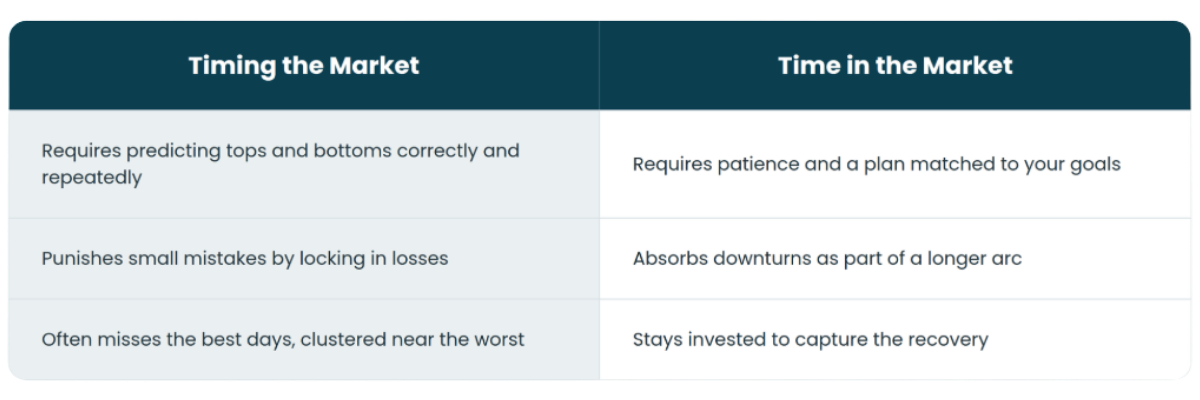
There is a long-held principle in our profession: Investment success comes from time. The reasoning is straightforward; consistently predicting the market’s peaks and troughs is nearly impossible, even for full-time professionals. Investors who move to cash in fear frequently miss the recovery that follows.
Consider one well-documented pattern. Many of the market’s strongest days occur very close to its worst days, often within the same brief window. An investor who exits the market to avoid the decline commonly misses the market rebound as well. Missing even a handful of the best days over a long time horizon can meaningfully reduce total returns. This is why a long-term investing strategy favors participation over prediction.
You can review our approach to disciplined portfolio management on our investments page.
What History Shows About Corrections and Recovery
The historical record is instructive. Downturns, including severe ones, have been followed by recovery when measured over sufficiently long horizons. No single decline, however alarming in the moment, has permanently defined the trajectory of a patient, diversified portfolio.
The decisive variable is time horizon:
- Over days and weeks, markets can appear chaotic and unpredictable.
- Over years, the influence of any single difficult stretch tends to diminish.
- Over decades, the pattern of steady growth becomes far more visible.
This is precisely where generational wealth planning shows its strength. Families who plan across decades, rather than quarters, are positioned to let time accomplish what timing cannot. The benefits of long-term investing compound most powerfully across generations, which is the horizon on which legacies are built and preserved.
The Behavioral Trap & How a Fiduciary Helps
Much of the damage investors suffer is self-inflicted, and the culprit is behavior rather than markets. Two tendencies can be especially costly:
- Loss aversion: The well-studied finding that losses feel roughly twice as painful as equivalent gains feel pleasant. This imbalance pushes people to act rashly.
- Emotional selling: Liquidating investments during a decline, locking in losses, and then standing aside during the eventual recovery.
This is where a fiduciary partner earns its place. As a fiduciary, The Family Heritage Trust Company is legally bound to act in your interest, and part of that duty is helping to supply the discipline that emotion erodes. We serve as the steady hand that keeps the plan intact when instinct argues for abandoning it. What is long-term investing without discipline? Merely good intention. Discipline is what converts intention into a durable long-term investing strategy.
You can learn more about the professionals behind this discipline on our about page.
Practical Ways to Stay the Course
Staying invested is easier when the plan is designed and built well from the outset. A thoughtful long-term investing strategy typically relies on several reinforcing practices:
- Diversification and asset allocation: Spreading investments across asset classes and matching that mix to your goals and time horizon, so that no single event dictates the outcome.
- Dollar cost averaging: Contributing consistently over time, which reduces the temptation to try to time entries and smooth the effect of price swings.
- Revisiting the plan: When markets fall, the productive response is to review your goals and allocation.
These practices are deliberate, repeatable, and grounded in evidence, which is exactly the point. So what is long-term investing in practice? The steady application of sound habits, sustained across market cycles.
The Long View Is a Discipline
A long-term investing strategy is not a prediction about what the market will do next week. It is a commitment to patience, planning, and careful stewardship over many years. The benefits of long-term investing accrue to those who can remain steady when others cannot.
At The Family Heritage Trust Company, we help families hold that long view through every market cycle. If you think you would value a disciplined, fiduciary-guided partner for the decades ahead, we would welcome the conversation.