


Once a trust becomes irrevocable, whether it is irrevocable from the outset or becomes irrevocable upon a triggering event, its terms are generally locked in place. Yet laws change and families change, and the trust protector role is one tool estate planners use to address this contingency, though it is not the right fit for every plan.
What is a trust protector and does your estate plan need one? Today we’ll cover the powers the role can carry, how a protector works alongside a professional trustee, the trade-offs the role can introduce, and an honest framework for deciding whether it belongs in your plan.
Whether you are establishing a new trust or reviewing an existing one, understanding this safeguard can spare your family expense and conflict later.
What Is a Trust Protector?
A trust protector is an independent third party granted specific powers over a trust, separate from the trustee. The protector is named in the trust document, which also defines the exact scope of the protector’s authority. The role exists to provide oversight and flexibility after a trust becomes irrevocable.
Once found mainly in offshore and dynasty trusts, the role has become increasingly standard in U.S. estate plans as more families create trusts designed to last for decades.
Trust Protector vs. Trustee: What Is the Difference?
The trust protector vs trustee distinction comes down to management versus oversight. The trustee manages the assets and administers the trust day to day. The protector stands apart and intervenes only when the trust document calls for it.
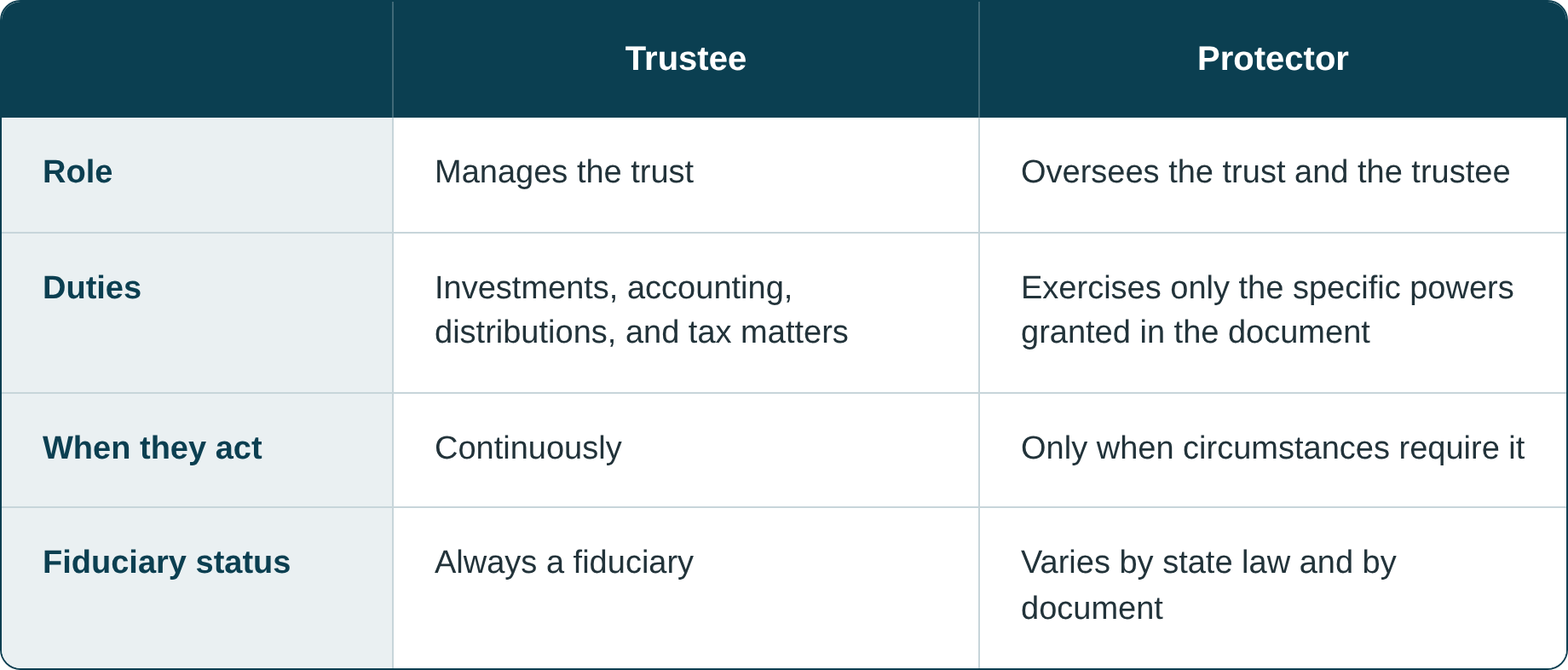
Pay attention to that last point. State laws differ on whether a protector is held to a fiduciary standard, and well-drafted trust documents often address the question directly. It is a detail worth raising with your attorney.
What Powers Can a Protector Hold?
A protector holds only the powers the trust document grants. Common provisions include:
- Removing and replacing a trustee: the most common power, and the family’s primary accountability mechanism
- Amending the trust to respond to changes in tax or trust law
- Resolving disputes between the trustee and beneficiaries before they reach a courtroom
- Adding beneficiaries, such as grandchildren born after the trust was signed
- Terminating a trust that no longer serves its purpose
Specificity in drafting is everything. A vague grant of authority invites confusion, while a precise one gives the protector a clear mandate and gives everyone else certainty about the limits of that mandate.
How Protectors & Professional Trustees Work Together
Some families hesitate to name a protector when a corporate trustee is involved, concerned that doing so suggests a lack of trust. In practice, a protector is less about second-guessing a trustee and more about giving the trust a practical way to adapt over time. The role can provide accountability if trustee service falls short, but its broader purpose is to help the trust remain workable when laws, tax rules, family needs, or other circumstances change.
The pairing works because each party contributes something different:
- The professional trustee provides continuity, investment expertise, and neutrality among family members, decade after decade.
- The protector gives the family a built-in mechanism to respond if the trustee needs to be held accountable, and to manage the trust document when future legal or practical changes require attention.
Consider a common example: A family establishes a multigenerational trust and names a corporate trustee for continuity and professional management. They then name a trusted advisor or longtime family friend as protector, with authority to remove and replace the trustee if service ever falls short, and to approve limited updates if future law, tax rules, or family circumstances make the original terms difficult to administer. The family gains a comfort mechanism but, more importantly, the trust gains a practical way to remain useful and workable over time.
At The Family Heritage Trust Company, we regularly administer trusts that include protector provisions, and we are equally comfortable when a family decides the role is not needed.
Do You Need a Trust Protector? An Honest Framework
A protector adds value in some plans and unnecessary complexity in others. The role makes a strong case for itself when:
- The trust is designed to last decades or span generations
- The family is blended, or conflict among beneficiaries is a realistic risk
- Beneficiaries or assets sit in multiple states, or changing tax laws could affect the plan
- You have concerns about a named trustee’s long-term suitability
The role may be unnecessary when:
- The trust is a simple revocable trust expected to distribute shortly after death
- The estate is modest and the assets are straightforward
- The family situation carries little potential for dispute
Cost is a fair question. Most protectors are compensated only when they act, so a protector who never needs to intervene costs little or nothing: this compared with the expense of petitioning a court to modify a trust, which can run $10,000 or more.
Where a Protector Can Add Complexity
An honest framework also requires the other side of the ledger. In some situations, naming a protector creates challenges of its own:
- Unsettled legal status: Where the document and state law leave the protector’s duties ambiguous, disagreements over those duties can end up in court, the very outcome the role is meant to prevent
- Friction with the trustee: Broadly drafted powers can blur lines of authority, slow administration, or create gridlock between the protector and the trustee
- Succession gaps: A protector who dies, declines to serve, or loses capacity leaves the trust with an empty provision unless the document names backups or an appointment mechanism
- Added cost and coordination: The role introduces another party, another potential fee, and another relationship for the family to manage over the life of the trust
- Concentrated power: Removal authority in the wrong hands can be used to pressure a trustee who is administering the trust exactly as written
None of these concerns rules the role out on its own. They are reasons to draft carefully and to weigh whether the circumstances of the trust justify the added structure.
Who Should Serve as Trust Protector?
Nearly anyone can hold the role, but independence is the governing principle: The protector should generally not be the trustee or a beneficiary. Good candidates include:
- Estate planning attorneys and CPAs
- Professional fiduciaries and trust companies that offer protector services
- Non-beneficiary family members with sound judgment and no financial stake in the outcome
Two drafting practices are worth discussing with your attorney: Name one or more backup protectors, or include a mechanism for appointing a protector in the future rather than naming one today.
A Safeguard Built to Last
The longer a trust is meant to last, the stronger the case for a trust protector. For shorter-lived or simpler trusts, the role can add cost and complexity without a corresponding benefit. Neither answer fits every family perfectly. The decision depends on your trust’s purpose, its time horizon, and the people involved.
To discuss how professional trust administration and protector provisions fit your family’s plan, contact The Family Heritage Trust Company to schedule a conversation.